Book Review: The Portsmouth Road by Charles G. Harper, first published in 1895
Updated: May 10
This article, written by Jackie Rickenberg, was published in the Thursley Parish Magazine in March and May 2026. It makes reference to the Murder of the Unknown Sailor, a crime so heinous that it still fascinates to this day.
Thursley History Society is building up quite the library of interesting books all concerning either the village, its occupants, buildings and/or surroundings. These can be lent out as required and expect to see them at many of the Society’s events throughout the year. As we have designated this year to transportation and its many facets, this month I am including passages from a book in our archives called The Portsmouth Road by Charles G. Harper, first published in 1895 and acquired by our Chairman, Sally Scheffers in her research for our society's year of transport in 2026.
It is a little jewel of a book, detailing the road from its London source, to its Portsmouth destination and everywhere in between. The road, of course, cut through our village and was a source of much folk lore and some incredibly mysterious goings on. I have included small extracts, but the book is a fascinating read with lovely illustrations by the author and “Old time Prints and Pictures”, a couple of which I have included here.
“The Portsmouth Road was measured from the Stones’ End, Borough. It went by Vauxhall to Wandsworth, Putney Heath, Kingston-On-Thames, Guildford and Petersfield; and thence came presently into Portsmouth through the Forest of Bere and past the frowning battlements of Portchester. The distance was seventy-one miles, seven furlongs; and our forebears who prayerfully entrusted their bodies to the dangers of the roads and resigned their souls to Providence, were hurried along this route at the breakneck speed of something under eight miles an hour, with their hearts in their mouths and their money in their boots, for fear of the highwaymen who infested the roads.
By 1821 the speediest journey was quoted as nine hours, performed in that year by what was then considered the meteoric and previously unheard-of swiftness of the “Rocket”, which, in that new and most fashionable of era of mail and stage-coach travelling, had deserted the grimy and decidedly unfashionable precincts of the Borough and the Elephant and Castle, for modish Piccadilly.
They were jolly coach-loads that fared along the roads in coaching days, and, truly, all their jollity was needed, for unearthly hours, insufficient protection from inclement weather, and the tolerable certainty of falling in with thieves on their way, were experiences and contingencies that, one might imagine, could scarce fail of depressing the most buoyant spirits”.

.
At this juncture, I digress from my planned article and literally go down a rabbit hole as I read about Mary Tofts of Godalming. I previously wrote an article about Hammer Ponds, in which it was mentioned that there was an area of farmed rabbit warrens nearby (hence Warren Park) which had disappeared in the middle of the eighteenth century. It was supposed that rabbit meat went out of fashion, but perhaps it was a result of Mary Tofts legacy.
“Godalming was a place notorious in the eighteenth century as the scene of one of the most impudent frauds ever practised upon the credulity of mankind. The story of Mary Tofts, if not edifying, is at least interesting. She was the wife of Joshua Tofts, a poor journeyman cloth-worker of this little town, and was described as of “a healthy, strong constitution, small size, fair complexion, a very stupid and sullen temper, and unable to write or read”. Stupid or not, she possessed sufficient cunning to maintain her fraud for some time, and even to delude some eminent surgeons of the day into a firm belief in her pretended births of rabbits. For this was the preposterous nature of the imposition, and she claimed to have given birth to no less than eighteen of them.

A Mr Howard, a medical man of Guildford, who claimed to have assisted Mary in giving birth to eighteen rabbits, seems, from the voluminous literature of this subject, to have been something of a party to the cheat; and if we did not find him a guilty accomplice, there would remain the scarce more flattering designation of egregious dupe. But Mr Howard, dupe or rogue, was extremely busy in publishing to the world the particulars of this extraordinary case. Public attention was now roused in the most extraordinary degree, and the subject of Mary Tofts and her rabbits was in everyone’s mouth.
The King (George I), too, was numbered among the believers, and things came to such a pass that ladies began to be alarmed with apprehensions of bringing into the world some unnatural progeny. “No one presumed to eat a rabbit”, and the rent of rabbit-warrens sank to nothing. But a German Court physician – a Dr Ahlers – who had proceeded to Guildford in order to report upon the matter to his Majesty, was rendered sceptical as much by the behaviour of Mr Howard as by that of his interesting patient. He returned to town, convinced of trickery, and finally Mary Tofts and her medical advisor were brought to London and lodged on the Bagnio, Leicester Fields, where, in fear of combined threats of punishment and an artfully-pictured operation darkly hinted at by Sir Richard Manningham, Obstetrician, she confessed that the fraud had been suggested to her by a woman, a neighbour of Godalming, who, with the showman’s instinct of Barnum, told her that here was a way to a good livelihood without the necessity of working for it. The part taken by Mr Howard has never been satisfactorily explained, but as he was particularly insistent that Mary Tofts deserved a pension from the King on account of her rabbits, his part in the affair has, naturally, been looked upon with considerable suspicion. Doctor and patient were, however, committed to Tothill Fields, Bridewell. (a prison located in Westminster, Central London and demolished in 1834 – Ed.).
Could this account for the disappearance of the rabbit warrens in Thursley? To read the original Warren Park article, please visit the website https://www.thursleyhistorysociety.org/post/warren-park-and-loseley-house The subject of transportation and the history of the Portsmouth Rd will be continued next month – with absolutely no mention of rabbits!
Parish Mag Article May 2026
As we started the history of the Portsmouth Road last time (albeit distracted by rabbits), we continue again this month. The book source that a lot of the information is from is “The Portsmouth Road” by Charles G Harper first published in 1895.
“A fine crowd of coaches left town daily in the 1920’s. The “Portsmouth Regulator” left at 8am, and reached Portsmouth at 5pm; the “Royal Mail” started from The Angel 7.15 every evening, arriving at The George, Portsmouth at 6.10 the following morning. Others had such inventive names, such as The Hero, The Rocket and The Perseverance.
Elderly ladies, travelling by coach, were not unreasonably afraid of the Devil’s Punch Bowl. It does not appear whether it was entirely the awful depths that alarmed them, or the chance, that presented itself to their imaginations, of seeing Auld Hornie himself., very black and terrible, skulking among the bilberry bushes. The parasitic wild plant, the Lesser Dodder (cuscuta epithymum), also grows in the hollow of the Punchbowl, sometimes so abundantly as to resemble red seaweed. In Cornwall, the rustics call it “Devil’s guts”. It strangles many other growths. Here in Thursley, the country-folk used to style it the “murder-plant”, and said it appeared first after the murder of the sailor (I am not including details of the Sailor’s murder here, as it has been covered in past articles, but should you wish to acquaint yourself with this gruesome tale, please go to thursleyhistorysociety.org). We return to the elderly lady:
A tale was at that time told of just such a nervous passenger who, with two or three nieces and servants, engaged the coach to London, on the understanding that the coachman should WALK the coach round the dreaded spot. It is a striking instance of how the anticipation of evil is generally worse than the realisation.
When the coach came to the Sailor’s stone, overlooking the wildest spot, the coachman alighted and pretended to be making some trifling alterations to the harness; the old lady gazing complacently into the vast dell beneath. She asked its name.
“Higgin-bottom, ma’am,” said the coachman.
“What a delightful, but singular-looking spot!” she exclaimed; and then the coachman drove on.
Arrival at Road Lane, the question often asked, “How far off to the Devil’s Punchbowl?” was repeated.
“We’ve passed it, ma’am!”
“Past it, and in safety? Bless me, where was it?”
“Where I stopped, and you asked the name of that deep dell – THAT was the Devil’s Punchbowl – Higgin-Bottom’s the right name.”
The body of the murdered sailor was buried at the little village of Thursley, and there, in the churchyard, shadowed by dark fir trees, stands a gruesome tombstone, an unconscionable product of local art, with a carving in relief of the three murderers in the act of dispatching their victim. Beneath this melodrama, the circumstances are recounted at great length, and some halting verses conclude the mournful narration.

Thursley itself is situated on an old road that branches from the newer highway upon entering Witley Common, and rejoined the ordinary route near the Royal Huts Hotel, Hindhead. The village is rarely visited by strangers. The old church stands in a commanding position, overlooking a wide tract of country, including the Hog’s Back, by Guildford, and the scattered ponds of Frensham. An old sun-dial on the tower has the inscription Hora pars vitae, and, like most of our clocks and watches, perpetuates in the numeral “IIII” the long-exploded fiction of the infallibility of kings. I wonder if anyone remembers the origin of the substitution of “IIII” for “IV” on nearly all the dials, whether sun-dials or clock-faces, of civilisation? Here is the story. The first clock that kept anything like accurate time was constructed by a certain Henry Vick in 1370. It was made to the order of Charles V. of France, who was known as “the Wise”. Wise he certainly was, in some respects; but Roman numerals were not within the sum of his knowledge. When Vick brought the King his clock, he looked at its movements awhile. “Yes”, said he, at length, “it works very well; but you have got the figures on the dial wrong”. “Surely never, your Majesty”, said Vick. “Yes”, replied the King, “that IV should be IIII”. “But your Majesty is wrong”, rejoined that not very tactful clockmaker. “Wrong!” answered outraged majesty, “I am never wrong! Take it away and correct the error”. Vick did as he was commanded, and so to this day we have IIII where we should really have IV”.

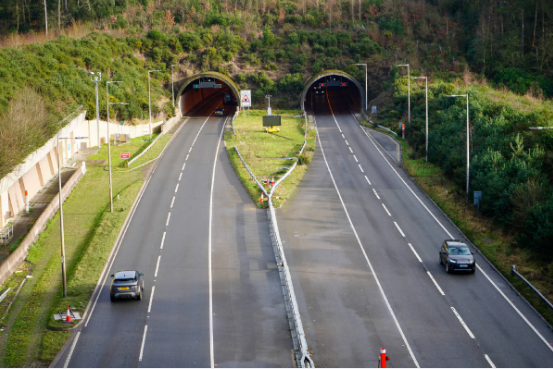
As we know, the route of the old Portsmouth Road was eventually completed to its modern-day condition when, in 2011, the Hindhead tunnel replaced the single carriageway with traffic lights, that caused the incessant traffic jams up at Hindhead. The Royal Huts Hotel, mentioned in the text, became a Happy Eater and now has new houses on that corner site.
Remember to visit the website for more info on the sailor’s murder and the Hindhead tunnel.