
Churchyard Walk, St Michael & All Angels, 18th June 2026
Updated: Jul 7
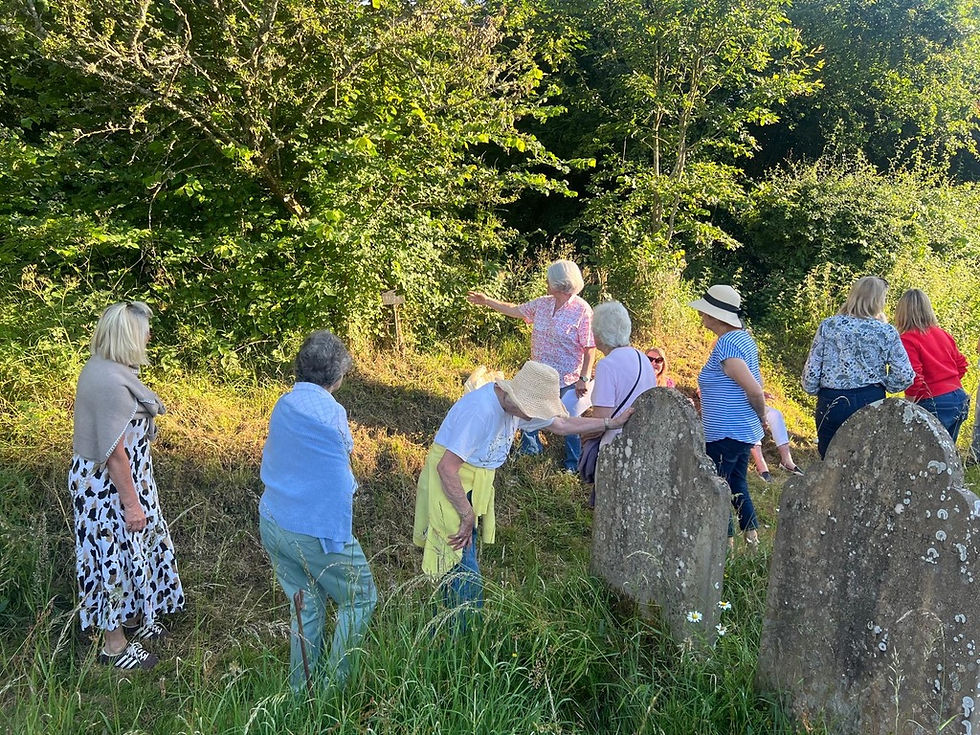
On a beautiful summer's evening, over 30 people had signed up for Thursley History Society's Churchyard Walk to learn something about the gravestones and people buried there. The group was divided into two, one led by Amanda Flint and the other by Sally Scheffers, Chairman of Thursley History Society.
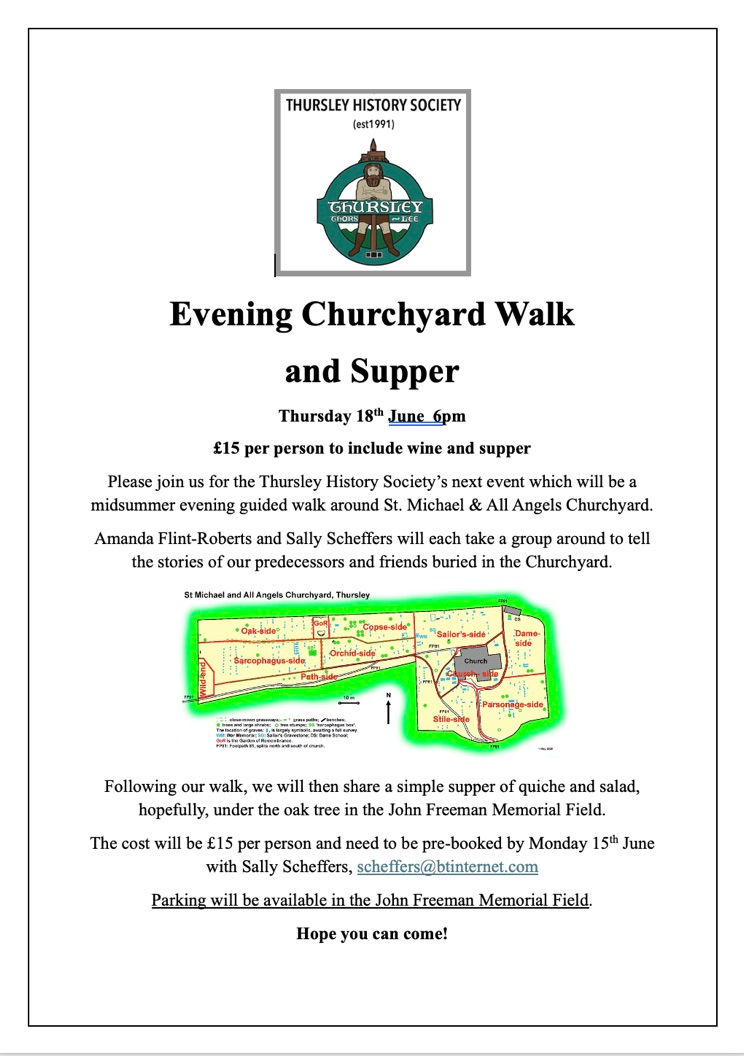

Before the group divided, Sally spoke in general terms about the church and churchyard:
St. Michael & All Angels
This Church has been a place of worship for nearly a thousand years and the land surrounding the church for much longer.
Historically a churchyard was an active burial plot attached to a place of worship, whereas a graveyard or cemetery represents a designated, and often secular, area established explicitly for the deceased. Until the 19th century churches and churchyards were the only places where people could be buried, and as such, are very important places for history and archaeology, revealing evidence of the past and of the lives of people who have lived and worked in the parish. They also provide a sanctuary for a rich diversity of flora and fauna, and some are classed as SSSI’s (sites of special scientific interest) but not ours – yet!
Graves in the churchyard should face east. Christians adopted the old Jewish custom of burying the dead with their feet towards the rising sun. It is also to face the Lord, who will approach from the east at the final Day of Judgement. Vicars are buried with feet facing the church to symbolise that they are still attending their flock.
Traditionally, most burials took place on the south side of the church. The north side was sometimes used for the burial of suicides, criminals, and infants who had not been baptised.
It is thought that the first Christian missionaries came to Surrey in the late 7th century. The earliest documented evidence includes the founding of a minster at Farnham by King Caedwalla of Wessex in 688 and these early Christian missionaries preached to the villagers at the side of the preaching cross. In the 6th and 7th centuries, wooden crosses marked the spots where priests or monks preached to the local community. The wooden cross was replaced by a more permanent stone cross, around which services were held. Later still a wooden church might well have been erected before the Saxons built the first small stone church here in Thursley.
When some of the congregation died, they were buried at the side of the preaching cross before the first village churches were built. So many of the churchyards are older than the churches and it is more than likely that this is the case here.
Until the opening of the first public cemeteries in the 19th century churchyards were the only place people could be buried. Over the centuries countless thousands of burials took place, and repeated burials raised substantially the level of earth above that of the churchyard paths. A conservative estimate is that there are 2,500 Christian bodies buried here. By the mid-19th century churchyards were becoming unsanitary and in 1881 the local Board of Health ordered the closure of our churchyard. As a result, Miss Frederica Harriet Rushbrooke of Surbiton in 1882 gave one rood and two perches approximately a quarter of an acre to extend the churchyard. This small parcel of land came from Hill Farm and Wheelers Farm – the quarter acre from an estate of 2,400 acres! In 1926 Captain Rushbrooke gave a further half-acre, still known as ”the new part” of our churchyard.
In our churchyard we have a fine collection of yew trees. Because of their great age, yews were associated with pre-Christian burial grounds. In symbolic terms, yews do not only represent death, but also resurrection. Their evergreen foliage was highly valued and used for religious and secular festivals. One of our yews, an “Irish” yew (Taxus baccata “Fastigiata”) by the Old Parsonage is thought to be from 500 to 800 years old and serves as a reminder of an earlier, pagan time. Our other notable yew is by the wall of Hill Farm, thought to be several hundred years old and a “Dovastoniana” specimen of Taxus baccata.
Not all burials have been outside and in 2005 two coffins were discovered under the chancel of the church. The great and good could be interred inside the church, hence the term “stinking rich” from the smell! Luckily, for the parishioners of Thursley Church Edmund Woods (buried 1792) and his wife Ann (buried 1812) had highly decorated lead lined coffins. The vault is of a very considerable size and perhaps Edmund planned for more members of his family to be interred inside the church. However, in 1857 it became illegal to bury within a consecrated building.
The first recorded burial here was Margaret Denier on the 24th October, 1613. Individual plots and headstones were not common until the 17th century. As you look around the churchyard you can see a variety of grave markers. The oldest burial stone, as recorded by Reverend Arthur “Bill” Mills, belongs to Elizabeth Tichbourne who died in April 1666 at the age of 21.
The word coffin probably derives from the Saxon “cofa” meaning cave. The wooden coffin is of comparatively recent origin. Here in Thursley the coffins would have been made in the wheelwrights’ shop and were probably elm. Early coffins in the 11th and 12th centuries would have been a single block of stone, hollowed out to receive a body. These stone coffins were never buried deeply. They were sealed by a stone lid, usually with a cross and a symbol denoting the deceased rank or profession. These included a broadsword for a knight or a chalice and bible for a priest.
For the majority who were poorer they were not buried in coffins. Instead, their bodies were wrapped in a cloth shroud. Later, they may have been placed in the “parish coffin” and then taken out and placed in a communal grave.
One extraordinary relic from the past was the bier which used to be housed in the Dame School (traditionally a small building of wood or brick in the corner of the churchyard near the entrance was used to house the parish bier) and which the History Society had on display at a summer exhibition years ago. It was used for transporting a corpse from the village to the graveside along what were known as “coffin paths”. One of these is the bridleway and byway by Punch Bowl Farm to Ridgeway Farm. The lower path by the wall of Hill Farm is also known as the “coffin path”. The bier was a wooden frame with rollers and four handles and four wheels. Reverend Peter Muir donated our bier to the National Funeral Museum (UK) in Beckton, East London in the 2000’s.
References: National Churches Trust; Tales from a Country Churchyard – Guy J Singer; Witley & Thursley Parish Churches – Alan Bott
Excerpt from Old West Surrey by Gertrude Jekyll, 1904
“In the older days, monuments in country churchyards, erected to the memory of people of means and of some importance of standing, were specially designed by a competent architect. Often they took the form of fine altar- tombs – monuments of much dignity; excellent in proportion, with sufficient and well-drawn mouldings.
Even the humblest graves of all, where no stone or lasting memorial was ever to be placed, were most carefully covered with turf than they are now, and the newly laid turfs were bound with hazel or osier withies crossing each other diagonally, with wooden pegs, where one withie passed over the other.
Graves of people of a middle class had head and foot stones; the head-stone either plain as to its face or with some ornamental carving in low relief; but usually with the upper line pleasantly treated in one or two traditional ways.
The monuments, if any, to members of the labouring class, or people who could not well afford stone, were the dignified but unpretentious grave-boards. Each district had a traditional pattern of finial at the heads of the posts, and of ornamental outline of the lower edge of the board. The latest I know in this district bears the date 1861.
It is much to be regretted that this simple form of monument should have passed out of use. The cast-iron crosses from the ironmongers’ pattern- book are but a sorry substitute for the honest piece of carpenter’s work, made in the dead man’s own village, perhaps by a younger man of his own blood; in any case by one who was known to him.”
Notes on the 1999 Edition by Jane Brown
Gertrude Jekyll is and was famous for her gardens but she was an accomplished artist-craftswoman. Her young life was spent at Bramley Park until aged 25 she moved to London. But Surrey was her home and she returned in 1878 to Munstead and turned her energies to gardening and photography.
'Old West Surrey' is her hymn to her happy childhood and her acutely-observed record of rural life and homes in the country around Godalming in the Victorian England that was already disappearing fast.
Miss Jekyll realised how quickly things were changing in her childhood countryside and took up photography to record ‘the ways and things of the older days’ as well as her growing garden. She used a Collins camera (made by C.G. Collins of Cochrane Street, St John’s Wood, London) and in 1895 ‘a new adjustment’ for the use of a wide-angle lens was available; a Dallmeyer lens was left at Munstead Wood with the camera, and the landscape photographs in the later chapters of Old West Surrey seem to have benefitted from this.
She was a pioneer; historians now confirm that the years between the 1860s and 1914 transformed life in Britain more completely than any other comparable era.
Some of the graves that were discussed:
George Forrest
George Forrest was named after his father. George senior was a legendary plant finder especially in Yunnan in the south west of China. In all he collected around 31,000 specimens including Gentiana sino-ornato and Rhodendendron forrestii. More than 30 genera have the specific epithet forrestii. There is a photograph on display of him in The Old Laboratory at RHS Wisley.
George junior was also green-fingered and adventurous. Having left school he attended the Heriot-Watt Technical College as the only student in the Tea Planters Course.
When he became 21 he sailed for India and worked on Tea Gardens in West Bengal. He wrote of his experiences which will soon be on our website. George captures the day-to-day life as well as his forays into the jungle. Travel in the more remote regions was by elephant as these animals could cross the rivers and sometimes the elephants had to swim!
George came back to England and took a job and tied cottage at the Valley Gardens, part of the Crown Estate and next door to Savile Gardens. Here he was employed to care for the trees and shrubs a role which was perfect from his experiences in India with acres and acres of delicate tea bushes.
It was a chance visit to Thursley Common that made George decide that he wanted to live here upon his retirement. He didn’t have much money but found a caravan at Warren Park and Tony Trimmings, the owner of the site, gave George a small garden as well. George joined the Horticultural Society Committee and was very well-respected and liked. So much so that Pat Coles on behalf of the Thursley Horticultural Society planted a pink hawthorn bush in his memory.

Sarah Herrington
The only iron grave marker in the churchyard is for Sarah. We know little of her and she died before the 1881 census on the night of Sunday 3rd April, so we don’t know where in the parish she was living. In the 1871 (Sunday 2nd April) census a Sarah Herrington lived at Redland Cottage in Kirdford and was a washer woman. Her place of birth could be Fernhurst but the writing isn’t crystal clear, she is 52 years old, the head of the household and married. This could be her.
Sarah was buried by Reverend Henry Brancker on March 10th. She had died a week earlier on March 3rd aged 63.
We do know that the cast-iron markers were made for people who couldn’t afford engraved stone memorials. They would have cost about 10 shillings plus tuppence per letter to have name, age, date and so on in the casting. By comparison a simple stone headstone would start at about 3 – 4 pounds plus four pence ha’penny per letter for engraving by a stonemason. (John Dawson, Facebook: Guildford Town Past & Present)
The cast iron “gravestone” is model No. 1 from Filmer & Mason’s Guildford Foundry. It was a prominent 19th century iron foundry and engineering firm. It operated primarily between 1850 and 1883 and was located at Mill Mead, which is the exact site where the Yvonne Arnaud Theatre now stands.
It may be that there were other cast-iron grave markers as a lot of the churchyard iron was removed for scrap metal in the Second World War. Personally, I think it is one of the most charming headstones in the churchyard.

Una Faithfull
An early print of the church, according to Rosemary Stephens pamphlet “Our Church” published Michaelmas 1980, shows the area on the south side full of these wooden memorials (known as leaping boards in Thursley) set at different angles, instead of being straight and with the inscription on the westward side (before about 1860) or the eastward (after that date) as the stone ones are.
The one remaining leaping board or “bed- board” in the churchyard belongs to Una (Maude) Faithfull 1875 – 1911. The, now illegible, epitaph reads:
“To them that knew her there is vital flame
In these the simple letters of her name
To them that knew her not be it but said
So strong a spirit is not of the dead”

Una was born in Hoddesdon in Hertfordshire on 27th April 1875 to Francis Grantham Faithfull and wife Edith nee Lloyd.
In 1881, aged 5, Una has an older brother and five older sisters. Her father is employed as Clerk to the Merchant Taylor Company and the family are living, plus two lodgers, at Court Fields in Broxbourne. (Frank Eustace 20; Amy Edith 17; Lilian Mary 16; Mabel Constance 13; Eveline Rose 11; Jessie Violet 10; Una Maud 5.)
In the 1891 census Una is living in 30 Lake Road in Wimbledon with her parents and three of her older sisters : Mabel Constance; Eveline Rose (Teacher in High School); Jessie Violet. In the 1901 census she was living at The Old Vicarage in Farnham and was a secretary, single and living with two of her older sisters: Amy (Secretary); Eveline (Principal of College Hall). Annoyingly, for the 1911 census on 2nd April Una is holidaying in Eastbourne at Burlington House Hotel on the Grand Parade and she is now listed as Head of Student Boarding House.
Una does appear in the newspapers:
The Alloa Advertiser of Saturday 4th December 1901 reports on the Silver Wedding of Lord and Lady Balfour of Burleigh and amongst the list of gifts is Miss Una Faithfull’s silver box.
The Morning Advertiser of Wednesday 29th November 1905 headlines, “A Hyde Park Incident”:
“Edward Bowler, 24, no home, bricklayer, was charged, before Mr. Denman, with attempting to steal a purse belonging to Miss Una Faithfull of Palace-gate Kensington. Miss Faithfull was walking with other ladies on Monday afternoon in Hyde Park, when the prisoner who was standing on the footway snatched at her purse, which she was carrying on a chain, breaking the chain, but failing to steal the purse. He then tried to run away, but was captured by Constable Cousins, 542A, who had been watching him from a place of concealment. The prisoner, in defence, said the affair was “an accident” owing to his having taken “a tidy drop of beer”. Assistant-gaoler Scott said that the accused had been three times before the Court for begging in Hyde Park. On the first occasion he was discharged with a caution, on the second he received 14 days, and on the third six weeks’ hard labour. Mr. Denman now sentenced him to three months imprisonment with hard labour.”
On May 5th 1906 in The Campbeltown Courier there is a full report of the society wedding between Mr. J R Moreton Macdonald of Largie and Miss Daisy Eyre Crabbe which took place at St. Matthew’s Church, Westminster. The fulsome report included a list of the Bride’s Presents and Miss Una Faithful gave a copy of Virginibus Puerisque by Robert Louis Stevenson.
“The Ladies’ Field” was a luxurious periodical, catering to upper-class women offering high society news, Edwardian fashion, and a coverage of women’s sports and pastimes. The Saturday 9th January 1909 edition reported,
“A recent marriage was that between Mr. Ernest Rev. Charles Jackson of Farnham, Surrey and Miss Eveline Faithfull, daughter of Mr. Francis Faithfull of 32 De Vere Gardens, Kensington. Dr. Walpole and the Rev. J. Salwey conducted the service, and Mr. Eustace Faithfull gave away his sister, while Mr. Arthur Seawell supported the bridegroom as best man. The bride was married in a travelling dress of shot blue crepe meteore and a white picture hat, trimmed with silver tissue and ostrich feathers, and was attended by her sister, Miss Una Faithfull, wearing a gown of mole-coloured silk crepe and a hat to match ornamented with pink and mauve flowers, the happy couple left early in the afternoon for their honeymoon, the reception having been held the previous evening at 32 De Vere Gardens.”
The Alloa Advertiser, which is still going strong today, of Saturday 30th April 1910 reports at length on the Wedding of Hon. Mary Bruce and Major Hope. The Hon. Mary Bruce is the eldest daughter of Lord and Lady Balfour of Burleigh. Again, the wedding gifts are listed and Miss Una Faithfull has given an “Edition of Jane Austen” (which is more exciting than the present of Major Mackenzie of Ord’s “Twelve doyleys of Maltese lace”!)
Sadly, on the 19th August 1911 Una died, aged 36, at Salviday or Saturday Cottages (?), Thursley and was buried here by Reverend Hudson on the 21st August. For her probate entry Una’s address is given as 20 Queensbury-place Kensington, Middlesex. She is listed as a spinster who died at Thursley near Farnham, Surrey. Probate to her brother, Frank Eustace Faithfull, secretary [company director of British railway companies in South America]. Una left £998 13s 2d which in 2026 would be worth about £152,500.

More about Una’s father: Francis Grantham Faithfull, born in 1845, was the son of Reverend Francis Joseph Faithfull, Rector of Hatfield, Hertfordshire. In May 1853 he was awarded a BA having studied at Trinity College, Oxford. In January 1868 Mr FG Faithfull MA was appointed as assistant private secretary to Sir John Pakington, the Secretary of State for War and later is recorded in the general news section of The Bristol Daily Post of December 17th, 1868, as having been appointed as private secretary to Lord Northbrook, Under- Secretary of State for War.Around 1870 Francis becomes Clerk of the Merchant Taylors Company, a position he held for twenty years, before he retired on the grounds of ill- health. A short retirement of 18 months and he died on 8th March 1892 in Wimbledon.
Francis Grantham Faithfull MA, FSA (Fellow of the Society of Antiquaries) was regarded as one of the best-known clerks of the great City Livery Companies.
Una’s mother was Edith Lloyd. In the 1870s she began editing and contributing articles to periodicals and wrote a single novel, “Love Me or Love me Not” in 1875. Edith died a few months after her husband in 1892. Both Edith and Francis have their sepia photographs in the National Portrait Gallery.
Una’s only surviving brother was Frank Eustace Faithfull. Frank served as secretary of Buenos Ayres Western Railway Company as well as director of the Buenos Ayres Midland Company and in 1911 he was instrumental in setting up The Argentine Club on the corner of Hamilton Place and Piccadilly. He married Blanche Annie Gwyn in 1891 and they had two children Basil and Edith. The family lived at 69 Oakwood Court, South Kensington. From passenger lists we know that Frank and Edith sailed in 1912 to Buenos Aires and to New York seven weeks before his death on 14th September 1915. Frank left Blanche £3140 2s 4d (in 2026: £418,000). Capt. Basil Faithfull of the Connaught Rangers was killed in action in Palestine on 10th March 1918. Blanche moved to Grove Cottage Loseley Park and thence to The Cottage Browns Lane with daughter Edith. Blanche died in January 1954 in Plymouth aged 91.
Una’s first sister: Amy Edith died on 13th December, 1949 and she had served as a Justice of the Peace (magistrate). She lived at Grange Cottage, Knowles Lane in Farnham and was the widow of the Very Rev. Dr. Joseph A. Robinson, K.C.V.O., M.A., D.D., formerly Dean of Wells (1911-1933) Dean of Westminster (1911-1933), Chaplain in Ordinary to the King, 1902 and Rector of St. Margarets, Westminster, 1899-1901. In the 1911 Census Amy was 47, single and living at Lambeth Palace where she was the secretary to the Archbishop of Canterbury. Three years later, in 1914, she married Joseph. He died in 1933.
Una’s second sister: Lilian, was a formidable woman. She was 15 years Una’s senior and became an English teacher, University lecturer, Headmistress, Women’s Rights Advocate, Justice of the Peace, Social Worker and Humanitarian.
She had been one of the “Steamboat” Ladies, a group of women who were barred from graduating from Oxford or Cambridge, despite studying there and meeting the academic criteria to attain a degree. They instead received ad eundem degrees from the more progressive University of Dublin. As a result, Lilian became a life-long campaigner for women’s access to higher education. She studied at Somerville College attaining a First in English as well as becoming the college tennis champion and captaining the hockey team. Whilst at Oxford she suggested the Lady Blue award to match the Blue awarded to college sportsmen. She joined King’s College London as vice-principal of the Ladies Department where she became friends with Virginia Woolf. She believed that topics of cookery, laundry and hygiene should feature as scientific subjects on the school curriculum - hence domestic science.
In 1895 she became the first president of the Ladies’ Hockey Association.
In 1907 she became Headmistress of Cheltenham Ladies College, a post she held for 15 years.
In 1920 she became one of the first female magistrates in the country.
Miss Faithfull was active as a social worker improving social conditions for the poor of London and chaired a committee to improve nutrition in children. She founded the Old People’s Housing Society in Cheltenham, later renamed the Lilian Faithfull Homes which are still going strong today. A 1924 novel, “The Constant Nymph”, by Margaret Kennedy modelled the Helen Butterfield character on the author’s former headmistress, Miss Faithfull. Chatto & Windus published Lilian’s books: “In The House of My Pilgrimage” 1924 and “You and I; Saturday Talks at Cheltenham” 1928. Lilian also wrote articles for newspapers including on the 8th November 1927, for The London Evening News, “When A Woman Is Sixty”. Lilian was made a Fellow of King’s College, London and received an honorary MA from Oxford in 1925. And in 1926 she was made a Commander of the Order of the British Empire. Lilian died on 2nd May 1952 at Faithfull House, one of the care homes she helped set up!
Una’s third sister: Mabel Constance in the 1901 census is recorded as the Head of High School at High House, Chilcomb Within, Hampshire. By 1910 she is now Principal of King’s Hall and living at 32 De Vere Gardens, Queen’s Gate. In the 1911 Census she too is holidaying at the Burlington Hotel, 11 Grand Parade, Eastbourne with Una, and is also listed as Head of House for Students. Less than 2 years later 12th March 1913 she is dead and is buried in Putney Vale Cemetery.
Una’s fourth sister: Eveline Rose, for whom Una was bridesmaid, lived in Farnham until her death in April 1961. Her husband, Ernest, was a solicitor and they lived on Castle Hill (“Cottons”) and The End House, Old Park Lane. Eveline’s sister Jessie and Una’s fifth sister lived with them and the 1911 census lists her as a Sick Nurse. Theirs was a comfortable home with 3 live-in servants.
Jessie Violet in 1915 was the Secretary for The Women’s United Services League Limited Company. Its objectives were to form clubs and places of recreation for the wives, mothers, widows, and other relatives or descendants of men serving, or who may have served in the Navy or Army. This was a prominent organisation led by influential figures like Lady French and Lady Jellicoe. Jessie Violet, Una’s fifth sister is here in this Churchyard. She was buried by H. Gordon French on 7th September 1938 but the Burial Register has a later pencilled comment to the side “Where Grave?” Jessie’s address was recorded as 11 Hornden Court W.8. (Kensington).
Having learned of Una’s family we seem to know little of why Una and Jessie are here in Thursley. Perhaps she was working as a school House Matron for her sister Lilian ? Hers was a well-educated, well to do family and she has very good social connections. And despite that she has a very simple wooden grave marker as opposed to a headstone and no strong connection to Thursley that is obvious. Today her leaping-board, though illegible, is the only one left and so Una has, thankfully, come to our attention – and blown our minds! Because there is a little extra which will be news to Una as well as us!
Una’s grandfather was Francis Joseph Faithfull (2nd July 1786), who was Rector of Hatfield and a former Canon of Lincoln Cathedral. He is also the Great, Great, Great Grandfather of Marianne Faithfull. And Una is Marianne’s Great, Great, Great Aunt!
(Father: Robert Glynn Faithfull; Grandfather: Theodore James Faithfull-Davies; Great Grandfather: Robert Vean Faithfull-Davies; Great, Great Grandmother: Cecilia Grantham Storr [previously married to Rev. Richard Davies]; Great, Great, Great Grandfather: Francis Joseph Faithfull
Edmund & Mary Moon
The name Moon is of Norman origin from Mohun near St. Lo. It is deeply rooted in Somerset and Dorset. And Thursley.
The first Moone listed in the Baptism register is Anne daughter of John 23rd May 1616.
Edmund or Edmond was the son of Edward. Edmund was baptised in Thursley on 11th September 1715. He married Mary Stovold in Thursley Church on 22nd December 1743 and they had two children that we know. Edmund (II) was baptised on 30th April 1745 and died on 13th July 1745. The burial records state that he was three and a half years old.
Daughter Mary (II) was born on Christmas Day 1746 and died aged 82 at Heath Hall. She was buried by Rev. Thomas Stevenson on 31st January 1829.

Mary (II) had two daughters, Mary and Ann.
The Baptism register reads Mary the daughter of Mary Moon baptised 3rd August 1775. No father given – indeed it is rare for the mother to be mentioned in the registers at this time. And not all vicars were kind: the entry for David Underwood born 19th February 1737 “son of the widow, a base born child”.
And for Ann 13th February 1780 daughter of Mary. Again no father listed. Ann died and was buried on the 1st March 1780.
So who fathered these two girls? According to Guy Singer’s detailed research Mary Moon (II) was the housekeeper at Heath Hall working for the unmarried John Yalden who was 24 years Mary’s senior. John loved Mary and it would appear fathered her two daughters. This tallies with the fact that John Yalden wrote Mary, now Mary Knowles, into his will in which he described her as his “natural daughter”.
Mary (III) married John Knowles of Farnham on 31st May 1800.
John Yalden died in 1801 and John Knowles through his wife Mary inherited. Mary and John’s sons were all given the middle name Yalden: John, Edmund and Henry. Upon the death of her husband in 1831 Mary Knowles undertook the building of a new house which was designed by John Perry who also was the architect responsible for The Pepper Pot in Godalming. Mary died in 1840 leaving the estate to Henry, her youngest son.
Edmund Moon died on 17th March 1786 aged 70 and was buried on 22nd March 1786.
Mary Moon predeceased her husband and died on 30th June 1782 aged 56 and was buried 3rd July 1782.
Their headstone was set into the wall of the Church when it was rendered and you can still see the bottom lugs that go into the ground. It is not known where it came from and the actual grave was probably built over during Reverend Brancker’s and Penfold’s enlarging of the Church in 1883.

Baptisms:
1616 23rd May Moone Anne daughter of John
1623 8th October Moone Elisabeth daughter of John
1626 19th November Moone Richard son of John
1629 Moone Thomas son of John
1657 (DoB) 24th February John son of John
1665 4th June Moone Thomas son of John
1684 1st March Moone Mary daughter of John
1686 26th December Moon John son of John
1690 22nd March Moone Thomas son of John
1692 1st January Moon James son of John
1695 1st January Moon Elizabeth daughter of John
1699 26th March Moon Sarah daughter of John
1715 11th September Moon Edmond son of Edward
1717 30th January Moon Ann daughter of Edward
1745 30th April Moon Edmund son of Edmund
1746 25th December Moon Mary daughter of Edmund
1758 9th June Moon Nathanniell son of Nathanniell
1760 29th February Moon William son of Nathanniell
1762 26th November Moon Mary and Elizabeth daughters of Nathanniell
1767 6th March Moon Elizabeth daughter of Nathanniell
1775 3rd August Moon Mary daughter of Mary
1780 13th February Moon daughter of Mary
1813 27th June Moon Catherine Frances of William and Frances of Hammer Pond. Victualler.
1813 Edmund Yalden Knowles son of John and Mary of Heath Hall. Gentleman
1815 19th February Moon Hannah Maria daughter of William and Frances of Hammer Pond, Victualler.
1821 24th July Henry Yalden Knowles son of John and Mary of Heath Hall. Gentleman
1831 11th September Moon Mary-Ann daughter of James and Mary Moon. Labourer
1834 16th March Moon Hannah daughter of James and Mary
1838 28th October Moon Susanna daughter of James and Mary
Marriages:
1673 6th November Thomas Tupper & Mary Moone
1743 22nd December Edmund Moon and Mary Stovold
1757 22nd December Nathaniel Moon & Elizabeth Stovold
1830 8th November James Moon & Mary Winter
Burials:
1758 17th June Nathannielle Moon son of Nathannielle
1762 16th January Anna Mariah Lambden from Guildford
1763 16th March Elizabeth Moon wife of Nathanniell
1764 3rd February Mary Moon daughter of Nathanell
1766 9th January Elizabeth Moon daughter of Nathanell
1774 14th January Mr. Edward Lambden
1780 1st March Ann Moon daughter of Mary
1781 22nd May Mrs. Mary Lambden
1781 24th December Mrs. Ann Yalden aged 85
1782 3rd July Mary Moon wife of Edmund
1786 22nd March Edmund Moon
1798 4th January Mrs. Mary Yalden aged 70
1801 19th August Mr. John Yalden aged 70
1802 2nd March Mr George Lambden Yalden
1807 15th December Mrs. Frances Yalden aged 72
1809 31st January Mary Lambden Yalden 46
1814 21st January Edmund Yalden of Godalming 89
1819 18th May Mary Yalden of Godalming 78
1820 Henry Moon of Hammer Ponds Infant
1823 7TH May William Moon of Half Moon 53
1829 31st January Mary Moon of Heath Hall 82
1831 25th May John Knowles of Heath Hall 53
Square Table Tomb:
George Lambden son of Edward and Mary Lambden.
Died 24th February 1802? Aged 36
George Lambden Yalden buried 2nd March 1802
Mary Lambden died 24th July 1809 aged 40
[PR: Mary Lambden Yalden buried 31st July aged 46]
Photographed by Gertrude Jekyll and in Old West Surrey Book.
A report in The Reading Mercury 25th June 1781:
“St. James, June 19. The King has been pleased to grant unto Mary Lambden and George Lambden, of Guildford, in the County of Surrey, his royal licence and authority to change their present name, and to assume and take the surname of Yalden, in compliance with the will of their late mother Mary Lambden deceased; and also to order, that this his Majesty’s concession and declaration be registered in his College of Arms.”
Large Table Tomb
To the left of the small table tomb.
Edward Lambden died 6th January 1771 aged 55; of London [PR; buried 14th January] 1774 Mary wife of Edward Lambden & daughter of Edmund & Mary Stillwell died 11th May 1781 aged 52 [PR buried 22nd May].

Edward Lambden aged 38, born about 1722, married 30 year old Mary Stillwell in St. Nicholas Church in Guildford on the 15th January 1760. Edward was from the City of London his Church being St. Mildred, in the Poultry. Edwards signed a marriage bond of £200 with Coles Fortrie, Gent of St. Nicholas Church. (In 1774 Coles Fortrie lived in Guildford. “Coles Fortrie, Gent, of exemplary Piety was buried July 12th 1771” as listed in the Burial Records of St. Nicholas, Guildford.)
The marriage bond was on a printed form and reads:
“Know all Men by these presents, that we Edward Lambden of the Prish of St. Mildred in the Poultry London in the County of Middlesex Glass-seller and Coles Fortrie of St Nicholas Guildford, Gent are holden and firmly bound to the Right Reverend Father in God Benjamin by divine permission of Lord Bishop of Wonton in the sume of two hundred pounds of lawful Money of Great-Britain, to be paid to the Right Rev Father or his certain Attorney, Executors, Administrators, or Assigns: To which Payment, well and truly to be made, we bind ourselves, and each of us by himself for the whole, our Heirs, Executors and Administrators, firmly by these Presents. Sealed with our Seals, Dated the 15th Day of January in the Year of or Lord, One Thousand Seven Hundred and sixty.
The Condition of this Obligation is such, That if hereafter there shall not appear any Lawful Let or Impediment, by Reason of any Pre-Contract, entered into before the Twenty-fifth Day of March, One Thousand Seven Hundred and Fifty-Four, Consanguinity, Affinity, or any other lawful Means whatsoever; but That Edward Lambden Batchelor and Mary Stillwell Spinster
may lawfully solemnize Marriage together, and in the same afterwards lawfully remain and continue for Man and Wife, according to the Laws in that Behalf provided ; and moreover, if there be not at this present Time any Action, Suit, Plaint, Quarrel, or Demand, moved or depending before any Judge Ecclesiastical or Temporal, for or concerning any such lawful Impediment between the said Parties; Nor that either of them be of any other Parish, or of better Estate or Degree than to the Judge at granting of the License is suggested, and by Him sworn to
And lastly, if the same Marriage shall be openly solemnized in the Church, or Chapel in the License specified, between the Hours appointed in the Constitutions Ecclesiastical confirmed, and according to the Form of the Book of Common-Prayer, now by law established; and if the above bounden Edward Lambden do save harmless and keep indemnified the above-mentioned Right Reverend Father, [inserted in left margin Comnifoary] and Surrogates, and all other his Officers and Ministers whatsoever, by Reason of the Premises; then this Obligation to be void, or else to remain in Full Force and Virtue.
Sealed and Delivered in the Presence of E Brewer Lumsgate
Also in the parish records is the burial in 16th January 1762 of Anna Mariah Lambden of Guildford. A close relative of the newly married Edward perhaps.
Martin Stilwell is the keeper of the Stillwell Family History and responded to my email enquiry as to why Edward Lambden paid £200 (£55,000 in 2026) to the Stilwell family to marry Mary Stillwell. And also why Mary’s offspring were commanded by their mother’s will to petition the King in order to change their surname to Yalden. Martin responded as follows:
“As to this Mary Stillwell. She was the daughter of Edmund Stillwell. She was their third daughter baptised Mary as the other two did not survive infancy. Edmund was one of the land-owning Stillwells of Lower House and Cosford. Due to some odd inheritance rule in the Stillwell line (think Downton Abbey plot) he inherited the Mousehill estate (but not Mousehill Manor) from his father. His son John (Mary’s brother) inherited the lands from his father and then inherited the Manor from his cousin, thus bringing land and house together. Makes Downton Abbey inheritance plot seem tame!
Daughter Mary inherited Sheephouse lands at Aldingbourne in Sussex from her mother Mary Stillwell, nee Whittingdon (widow), as a marriage settlement to Edward Lambden. Both Mary and her mother (Mary) were said to be of St. Nicholas, Guildford. Sheephouse was leased to Edward Lambden for one year for 5 shillings and then released to him after one year for sale. The inheritance would have been 1760, the year of her marriage, and that was only a year after her father had died. This makes me think that Edward Lambden may not have been the first choice as their son-in-law. Edward Lambdenwas a wealthy glass merchant from St. Mildreds in the Poultry, London (virtually where Bank junction/Station now sits).
As to children George and Mary Lambden (Yalden) all I know is that they changed their name to Yalden by Royal Licence in 1781. George would have been 15 and Mary 12. This is surely a decision of their mother’s ? Their father Edward Lambden had died in 1774. I have no re-marriage for Mary Stillwell/ Lambden so it is possible she was co-habiting with a Yalden and wanted to try and legitimise this by the children taking the name of Yalden. There is another possible reason. Edmund Stillwell’s aunt Ann Stillwell married a John Yalden . He died in 1773 (one year before Mary Stillwell’s mother Mary (Whittingdon). Maybe there was some Yalden inheritance going begging and Mary Lambden wanted to try and get it passed to her children. Naming them Yalden may have helped. Just a guess.
That’s about it as regards what I know happened. One of those twisted tales that may eventually come out of the woodwork.”
These graves were also discussed during the evening:
The brick barrel graves were constructed to deter grave robbers. Note the much shorter grave on the left, which was for a child. The first headstone is for Elias Moorey, and the second for the infant Maria Moorey. At the bottom of the second headstone appears a very short grave marker which is, in fact, the 'footer' of this grave:
The grave is for Elizabeth Everis (sister of Elias), wife of Arnold Everis. She was the daughter of Henry and Hannah Moorey whose headstone is on the right.
This is the grave of Marjorie Anne Tozer and Francis William Spernon Tozer, the children of Henry Edward Spernon Tozer, an artist of some renown and the village's postmaster.
This is the grave of the poet, John Freeman, and note the builit-in birdbath. Freeman's Field is on the other side of the church wall and this memorial coping stone is inscribed:
THE ADJOINING FIELD WAS PRESENTED TO
THE NATIONAL TRUST IN 1931 FOR PRESERVATION
AS A MEMORIAL TO JOHN FREEMAN
BORN 29 JAN 1880 DIED 23 SEPT 1929
After the tour of the graveyard, we dined on a warm June evening under the spread of the huge oak in Freeman's Field.


